Thursday, 16 May 2013

One half of a figure of eight.....with more to come


Vitoria Gasteiz ! ……….. not a place that conjures up much excitement in the normal course of events you might think.  It’s a largish town in northern Spain - best known for it’s Michelin factories and vast blocks of flats but to us this place gives us cause for celebration. 
We have now completed a full circle travelling through Spain and Portugal (as the map shows) and today we are making our way across the Pyrenees to France. 
5800 miles have been clocked up since we left the UK in September 2012 and I must admit that I have only driven about 10 of those miles  (just to make sure I can do it in an emergency).  So ……. well done Les - you deserve a medal, or perhaps a glass or two of the red stuff!


Wednesday, 15 May 2013

Picos de Europa


Blessed with sunny weather we made our way east into the Picos de Europa from Cangas de Onis not really knowing what to expect.   As we travelled on, the roads became narrower as the mountains became higher -  blue ice-melt rivers snaked down beside the road on most of the route until at last we saw the snow capped peaks for the first time.  Wow! 


Our terraced campsite near the small but interesting town of Potes had wonderful views and we were able to take a circular walk up to a nearby chapel with almost a full 180° panorama, far too wide to ever capture in a single photo.   The dull clunking ring of mountain cow bells could easily be heard in the still mountain air…… just one of the ‘ good to be alive moments’ that happen every now and again.


 The narrow Desfiladero de le Hermitage gorge, some 15 miles long had to be skilfully negotiated to Potes and back and thanks to Les’s careful driving I didn’t need to climb out of the van at all!   


View of Potes

Bearing in mind how close we are to the ferry ports of Santander and Bilbao we are sure we will be back to discover more of this fantastic mountain area.    


Those lovely cows! 

Wednesday, 1 May 2013

The Rally Hill Climb Time Trials


Whilst staying on the mountain top at Penha we discovered that Sunday was a rally hill climb time trials day.  It seems there is some association between a motoring group and the establishment of the mountain top facility – probably that motor vehicle were instrumental in the development as they brought labour and materials up the mountain.  In the church and chapels dotted around there are various plaques and dedications to the motorist associations.  Anyway, it seems the rally time trials are an annual event that sees plenty of spectators line the route up the top of the mountain.

Vehicles started arriving on the Saturday afternoon, a fair number of 1980’s cars such as Ford Escorts, Renault 5 GT Turbo (rear engined), Lancia Delta Integrale, Auto Bianchi (in both standard and Abarth form), VW Golf, Mini, etc., as well as some more modern cars such as Mitsubishi Evo, BMW 3 Series, Renault Clio, Citroen Saxo, Seat Leon and Alfa Romeo.  Plus what looked like three Radical open top racers.
 
On the Sunday morning all cars had to be scrutinised by the officials before heading off to the start area.  There was a measured route up the mountain to the finish line and each car took it in turns to race up against the clock.  Times were recorded and awards given for the different classes of car. The route was cordoned off and spectators lined the route – it was quite noisy and exciting as the cars used the full width of the road and came very close to the roadside barriers.

A few photos and a video clip for your delectation (those of you who are interested in motor sport – yes Dave, you know who I am talking about!):

Click on the pictures to see a larger version.


Auto Bianchi Abarth
Ford Escort
Ford Escort

Lancia Delta Integrale
Mini
Radical

Radical
Radical
Renault Clio

Renault 5 GT Turbo (Rear engined)

Seat Leon
Waiting at the start

Saturday, 27 April 2013

Perpendicular Porto


With our campsite being on the opposite bank to Porto we hopped on a local bus which took us to the heart of the city.  Looking at the map of Porto and it all seemed quite straight forward until we realised that 80% of the city is built on hills.  


However, we did manage to see the Stock Exchange Palace and the Romantic museum and Les climbed the vertiginous Clerigos tower (I chickened out at the first platform) before getting our breath back at Ribeira and walking over the Iron bridge to sample the port. 


There are many Port wine tours available but we had heard that Taylor’s has a lovely view over the city so …. on we slogged, up yet another hill.  What a reward awaited us -  an informative tour of the cave, three ports to try:-  1) Chip-dry  2) Late bottled vintage 3) 2009 Vintage Tawny and just for luck we treated ourselves to a 20 year old Vintage taster.  Yes, you have guessed it …… the 20 year old was the best.  Oh, and Spot came with us today of course.   


Thursday, 25 April 2013

A most unusual place to spend the night.


National Forest of Bussaco is a 105 hectare forest which contains more than 700 species of trees, a Palace (now a five star hotel) and a Carmelite convent.  After paying the 7€ entrance fee we confirmed it was OK to stay the night and continued up the hill bypassing the car-park, as there were heavy tree felling operations going, on and parking by the trees next to the 5*Hotel.  A much better view thanks.


There was a hermitage here in the 6th century inhabited by Benedictine monks but in 1628 the Carmelite order extended.  They built a convent and introduced exotic species of trees and shrubs, laying cobbled paths and enclosing the forest within walls.  There is evidence that during the Peninsular War the future Duke of Wellington stayed at the convent the night of his victorious battle in 1810 (not sure which room he was given as they are all about 6 foot square!)
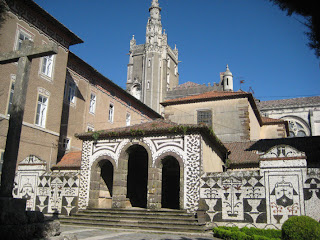
 
The Convent


In 1834 when religious orders were abolished in Portugal, the forest became state property.  The Palace was built in 1907 as a royal summer residence but then the monarchy was abolished three years later so the royals hardly got a look in.  All to our benefit.
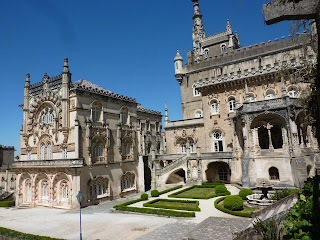
The Palace Hotel


Having spent the day there we followed most of the various paths which lead to ponds, waterfalls and chapels together with one area containing a collection of tree ferns from new Zealand.  One really steep path, which leads eventually to the highest point at 545 metres, contains depictions of the ‘stations of the cross’ inside dark square stone structures.  We only saw three of them (path too steep) but where amazed by the detail of the terracotta figures within. 


Sadly, there was a very bad storm on 16th January this year and evidence of the devastation is everywhere.   400 year old trees with their tops torn off, others that have crashed through a hermitage building and the visitors’ centre and lots of paths are now a bit tricky to negotiate.  


Lots of hard work is being done to clear all this up ……..  hence the closure of the car-park!! 
     

Friday, 19 April 2013

A Little Bit of Culture


We have travelled into the heart of the countryside north of the Tejo river which is an altogether more prosperous region dotted with various monasteries.  Deciding that a trip to Fàtimar (the Lourdes of Portugal) would be a taking things a bit far we opted to take a look at the largest Roman remains in Portugal, together with just two of the monasteries on route. All world heritage sites of course!


The church and Cistercian Monastery at Alcobaça date from the 12th Century and once housed 999 monks, who, between prayers  (as the quidebook seems to infer)  had a grand old time in “ this distinguished temple of gluttony”. The refectory had a water channel built through the middle of the room so that a tributary for the nearby river could provide a constant supply of fresh fish.   In the attached church, the lady in the finely carved tomb was murdered by her prospective father-in-law because of her family’s potential Spanish influence, only to be reunited with her prince once he became king two years later!  He died seven years after that and they now resided in opposite chancels of the church.


Manueline style doorway

Batalha – This monastery was built after a Dom Joâo of Avis won a major battle against Juan 1 of Castile in Spain who was claiming the Portuguese throne in 1385.  Dom Joâo’s army was very much outnumbered even though he was also assisted by a few hundred English soldiers, so he called on the Virgin Mary for help and vowed to build a superb abbey in return for victory. The whole place is enormous with two cloisters and an unfinished chapel and attached to the church, like the one at Alcobaça it has plain arches that reach far above your head – really quite serine especially when the sun shines through the stained glass windows.  The stone carving is very fine and almost gives the appearance of lace around the cloisters.     


Roman ruins of Conimbriga    -  The original settlement dates back to the Celtic times but the Romans came here in the 1st Century AD and it  blossomed as a major city on the route from Lisbon with well to do mansions and baths.  However, because of threats from invading tribes in the 3rd Century the townsfolk threw up a huge defensive wall around the town but for some reason, it went right through the centre of the eastern side with some houses left on the outside! The Suevi tribe eventually seized the town and the inhabitants fled to neighbouring Coimbra saving it from destruction. It is set in a very peaceful valley with the remains of a 3km aqueduct leading up to the bathing complex.   The original area was huge and the mansions and baths are easily recognizable and it looks as though there is a vast amount still to be excavated.